
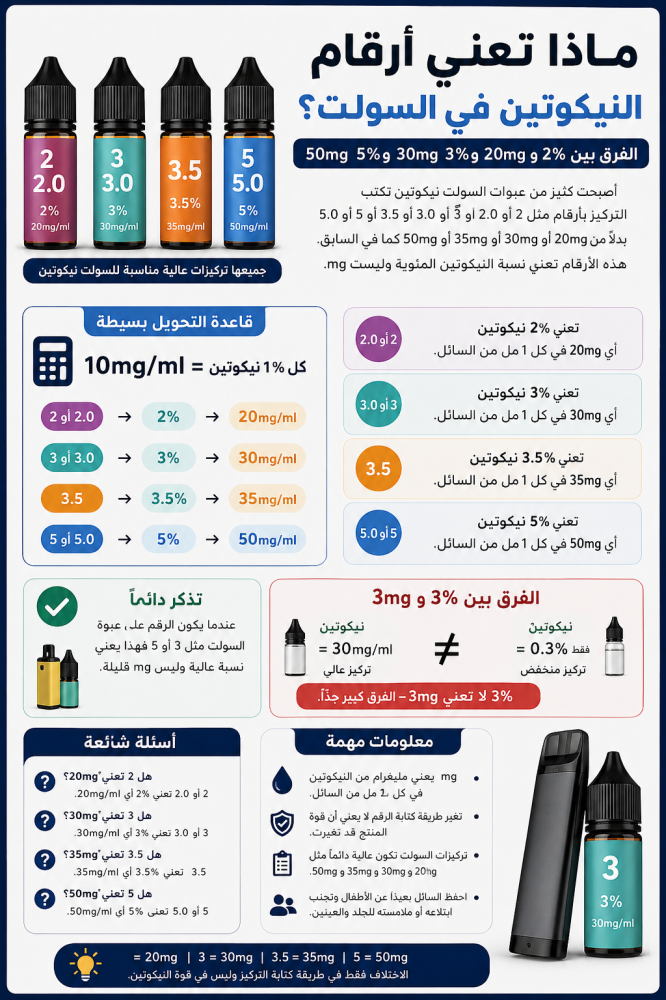

Recently, a new way of writing nicotine strength on salt nicotine packs has become widespread. Instead of writing 20mg, 30mg, 35mg, or 50mg as was common previously, many companies now write the strength in forms such as:
2% or 2.0 or 2
3% or 3.0 or 3
3.5% or 3.5
5% or 5.0 or 5
This change caused confusion for some customers, especially when they saw a number like 3 or 5 without mg or a percentage sign written next to it.
However, in nicotine salt packets, these numbers indicate the percentage of nicotine. Therefore, the number 3 means 3%, or 30mg, and the number 5 means 5%, or 50mg.
In this article we will explain the meaning of nicotine numbers in salt and how to convert between percentage and mg.
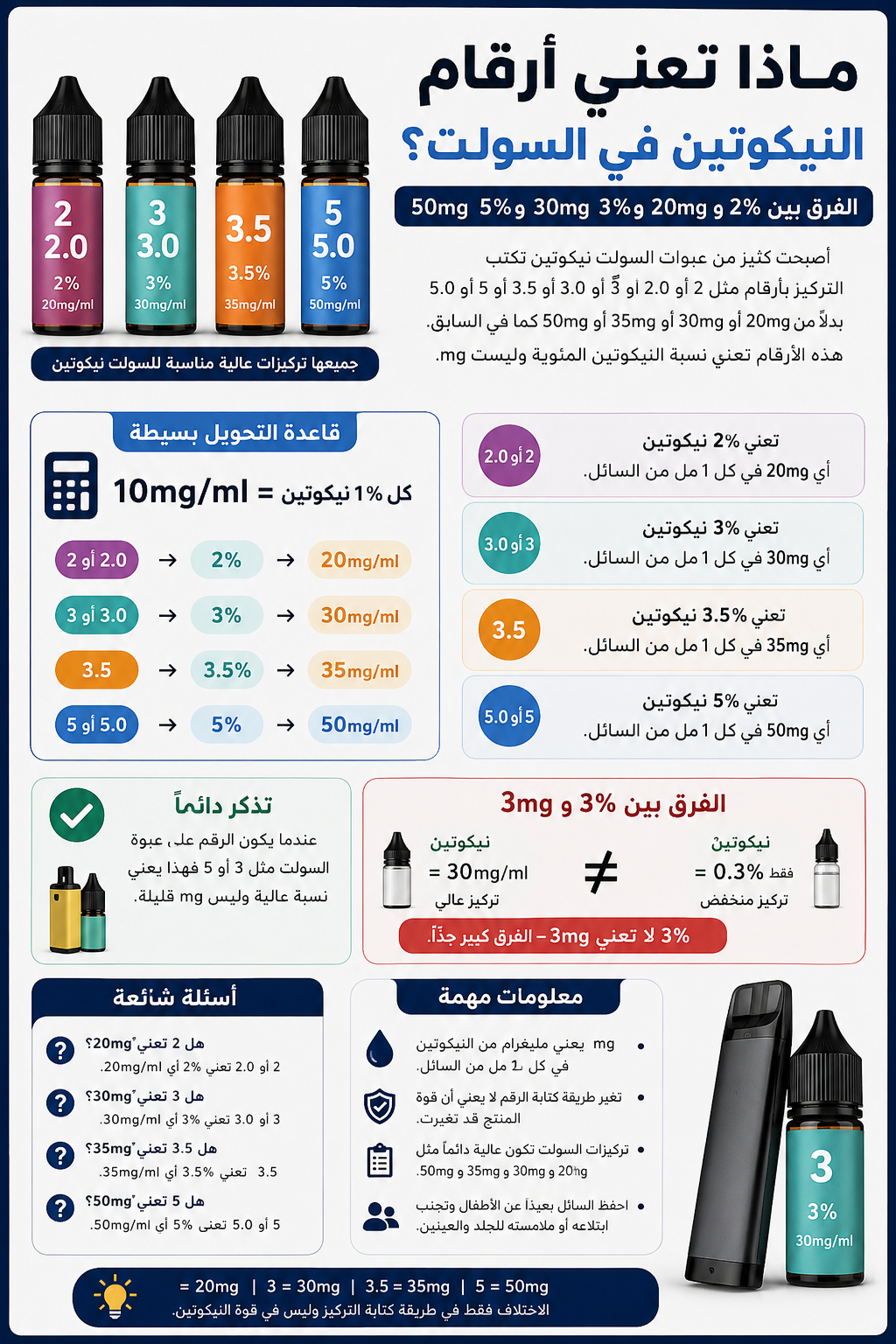
Why do salt packets now say 2, 3, or 5 instead of 20mg, 30mg, and 50mg?
Most salt nicotine packs previously displayed the concentration in milligrams per milliliter, such as:
- 20mg
- 30mg
- 35mg
- 50mg
In newer editions, many companies now display concentration as a percentage or decimal number, such as:
- 2%
- 2.0
- 3%
- 3.0
- 3.5
- 5%
- 5.0
The difference here is only in the way the concentration is written, and not in the strength of the nicotine itself.
When the company replaces the writing of 30mg with the number 3 or 3.0, it means a concentration of 3%, which is equal to 30mg/ml.
How to convert the nicotine percentage in salt from % to mg
The method for converting nicotine concentration is simple:
Each 1% nicotine equals 10mg/ml.
Therefore, the number written on the salt container is multiplied by 10 to determine the concentration in milligrams.
The transfers are as follows:
- 2, 2.0, or 2% equals 20mg/ml
- 3, 3.0, or 3% equals 30mg/ml
- 3.5 or 3.5% equals 35mg/ml
- 5, 5.0, or 5% equals 50mg/ml
What does 2 or 2.0 mean on a salt container?
If the product contains nicotine salt and it is written on the packaging:
- 2
- 2.0
- 2%
- 2.0%
All of these mean that the nicotine concentration is:
2% = 20mg/ml
That is, every 1 ml of liquid contains 20mg of nicotine.
The number 2 on the Salt package does not mean 2mg, but is an abbreviation for 2%, which is equivalent to 20mg.
What does 3 or 3.0 mean on a salt container?
When the product contains nicotine salt and it says:
- 3
- 3.0
- 3%
- 3.0%
All these methods point to the same focus:
3% = 30mg/ml
Therefore, the Salt pack that previously came labeled 30mg may come in the new edition labeled 3 or 3.0.
The number 3 here does not mean that the product concentration is 3mg, but rather 3% or 30mg/ml.
What does 3.5 mean on a salt shaker bottle?
If it says on the salt container:
- 3.5
- 3.5%
This means:
3.5% = 35mg/ml
That is, the product contains a concentration of 35mg of nicotine per 1ml of liquid.
Some companies used to write 35mg on previous packages, then they started writing 3.5mg in the new editions.
What does 5 or 5.0 mean on a salt container?
When one of the following numbers appears on the salt container:
- 5
- 5.0
- 5%
- 5.0%
The intended meaning is:
5% = 50mg/ml
The number 5 on the Salt package does not mean 5mg, but rather indicates a concentration of 5%, which is equivalent to 50mg/ml.
Therefore, the package labeled 5 or 5.0 is of the same strength as the one previously labeled 50mg.
Converting nicotine levels in salt
If the number written on the salt packet is 2 or 2.0, this means that the nicotine content is 2%, which is equivalent to 20mg/ml .
If the number written is 3 or 3.0, this means that the nicotine content is 3%, which is equivalent to 30mg/ml .
If the number written is 3.5 , this means that the nicotine content is 3.5%, which is equivalent to 35mg/ml .
If the number written is 5 or 5.0, this means that the nicotine content is 5%, which is equivalent to 50mg/ml .
Does the number 3 on the Salt packet mean 3mg?
No, the number 3 on a salt nicotine pack usually means 3%, i.e.:
3 = 3% = 30mg/ml
This does not mean that the product contains only 3mg.
A 3mg concentration usually appears in some regular low-nicotine vape liquids, and not in salt packets which usually come in higher concentrations.
Therefore, a distinction must be made between:
- The number 3 on the salt container means 3% or 30mg/ml
- Writing 3mg/ml explicitly means a concentration of 3mg per ml.
The difference between 3% and 3mg
Despite the similarity in numbers, there is a big difference between 3% and 3mg.
3% nicotine equals 30mg/ml.
As for:
3mg/ml equals only 0.3%.
This means that a 3% concentration is ten times stronger than a 3mg/ml concentration.
But when the product is nicotine salt and the number 3 or 3.0 is written on the package, it means 3% or 30mg/ml, not 3mg.
Does the number 5 on the salt packet mean 5mg?
No, the number 5 on the salt container means:
5 = 5% = 50mg/ml
It does not mean 5mg.
Salt packets usually come in high concentrations such as 20mg, 30mg, 35mg and 50mg, so some companies use the numbers 2, 3, 3.5 and 5 as an abbreviation for percentage.
Why don't the numbers 2, 3, 3.5 and 5 mean low concentrations in salt?
The reason is that salt nicotine products are typically made with higher concentrations than many regular vaping liquids.
Therefore, when the company writes the number 2 on the Salt package, it does not mean 2mg, but rather 2% or 20mg.
In the same way:
- The number 3 means 30mg
- The number 3.5 means 35mg
- The number 5 means 50mg
This method has become common on newer editions, especially when the packaging design is based on displaying the percentage instead of writing mg.
Has the strength of the Salt changed in the new editions?
No, changing the way the number is written on the packaging does not necessarily mean that the concentration of the product has changed.
For example:
- A pack labeled 20mg and a pack labeled 2% have the same concentration.
- A pack labeled 30mg and a pack labeled 3 or 3.0 have the same concentration.
- A pack labeled 35mg and a pack labeled 3.5mg contain the same concentration.
- A pack labeled 50mg and a pack labeled 5 or 5.0 have the same concentration.
The only difference is that older editions used mg, while more recent editions use the percentage or decimal number.
What does mg/ml mean in nicotine salts?
The abbreviation mg/ml means milligrams per milliliter.
When the salt concentration is 30mg/ml, this means that every 1ml of liquid contains 30mg of nicotine.
However, when the concentration is written as 3%, it is a different expression for the same concentration:
3% = 30mg/ml
In the same way:
5% = 50mg/ml
Frequently asked questions about nicotine levels in salt.
Does 2 mean 20mg in salt?
Yes, the number 2 or 2.0 on the salt container means 2%, i.e. 20mg/ml.
Does 3 mean 30mg in salt?
Yes, the number 3 or 3.0 on the salt container means 3%, i.e. 30mg/ml.
Does 3.5 mean 35mg?
Yes, the number 3.5 on the salt container means 3.5%, i.e. 35mg/ml.
Does 5 mean 50mg in salt?
Yes, the number 5 or 5.0 on the salt container means 5%, i.e. 50mg/ml.
Is 3% the same as 30mg?
Yes, 3% nicotine equals 30mg/ml.
Is 5% the same as 50mg?
Yes, 5% nicotine equals 50mg/ml.
Is 3% the same as 3mg?
No, 3% equals 30mg/ml, while 3mg/ml equals only 0.3%.
Why do some packages now say 3 instead of 30?
Because some companies now use percentages instead of mg, the number 3 means 3%, or 30 mg/ml.
Why does it say 5.0 on some salt containers?
The number 5.0 is another way of writing 5%, and it is equivalent to a concentration of 50mg/ml.
Summary
The new nicotine numbers written on salt packets are a different way of displaying the same concentration that was previously written in milligrams.
The conversion will be as follows:
- 2, 2.0, or 2% means 20mg/ml
- 3, 3.0, or 3% means 30mg/ml
- 3.5 or 3.5% means 35mg/ml
- 5, 5.0, or 5% means 50mg/ml
Therefore, when you see the number 3 on a nicotine salt pack, it does not mean 3mg, but rather 3% or 30mg/ml.
Similarly, the number 5 on the salt container means 5% or 50mg/ml, not 5mg.
The difference between the old and new packaging is only in the way the concentration is written, while the nicotine strength remains the same.